|
|
|
|
|
 |
 |
|
||
|
The Syfrewast Family An Extract by Montague Burrows This ancient family, like the Brocases and Foxleys,
had a connection with both Berkshire and Hampshire. As lords of Freefolk,
they have left their name in the latter, possibly also in the former
county. Freefolk Manor is still legally described as 'Freefolk
Syfrewaste' and in the diocesan records the technical term is 'Freefolk
cum Syfrewast'. Freefolk itself, the 'Frigefolc' of Domesday Book, was
only the name of a manor, with manor-house and chapel. The latter is now
the parish church of the united parishes of Freefolk Manor and
Laverstoke. In the Brocas deeds, the family come before us as lords of Clewer,
from 1354 to 1384, and we find them in connection with the family by the
marriage of John, son of Sir John de Syfrewast, with Elizabeth Warbelton;
but beyond this there is no information to be obtained as to their
pedigree. The earliest notice of the family given in the 'History of
Hampshire' (Woodward and Wilks) is in 1255, when Robert de Syfrewast is
found at his death seised of two knight's fees in that county. He leaves
a son, William, a minor, whose wardship and marriage are bought by
Bartholomew Pecche for 600 marks [There appears to be some confusion
here. Robert & his son, William, lived in the early 12th century.
Another William died in 1244 and the wardship of his son, Nicholas, was
purchased by Bartholomew Pecche]. We next hear of a knight of the
family, Sir John de Syfrewast, taken prisoner at Bannockburn [in
1314] (Cont. Trivet), and may suppose him to have been son of the
last-named. This was perhaps the same John who was summoned in 1297 to
do, military service for lands in Somerset and Dorset (Parl. Writs). In
the next generation we find a William de Syfrewast and Ellen his wife
buying land of Adam Fowler (Kerry's 'Hundred of Bray');
and Roger, in 1354, witnesses a deed of Sir
John de Brocas, by which the latter hands over to trustees all
his estates in Clewer, Bray, & co. We cannot place these as yet in
any pedigree. When Sir John Brocas makes the other family deed already
noticed, passing all his estates to his son and son-in-law in trust, one
of the witnesses is John de Syfrewast, not yet a knight. But when this
John grants a license to Sir Bernard
Brocas to assign a portion of his manor of Clewer-Brocas for the
endowment of the chantry in Clewer
Church, he is a knight and lord of Clewer. It is possible that
this estate of Clewer, held under the King in capite, may have been
granted to the Hampshire family as a reward for services in the Scottish
Wars and this second knight of the family probably won his spurs in the
French Wars, since we trace his name in the Gascon Rolls. It was
evidently a family of gentlemen and soldiers, not of great landed
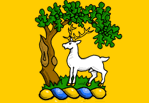
proprietors. Fortunately, the deeds enable us to produce a drawing of
the family coat-of-arms. Antiquaries may yet recover a good deal more
about these Syfrewasts. Originally entitled 'The Syfrewasts' and reproduced from Montague Burrows' 'The Brocas Family of Beaurepaire' (1886).
|
|
||
| © Nash Ford Publishing 2004. All Rights Reserved. | |
|||