 |
|
|
|
|
 |
 |
|
||
|
The
famous poet was the son of Alexander Pope Senior, a rich merchant and
linen-draper, and of Edith, daughter William Turner of York. Alexander
Junior was born in Lombard Street in the City of London; but before he had
reached his twelfth year, his father - having recently converted to
Catholicism - bought a small estate (now Pope's Manor) at Binfield
in Berkshire. Here, the boy grew up. He had already begun to lisp in
numbers, had dramatized scenes from Homer and had met Dryden. His schooling
was obtained at various private Catholic schools and, at home, from priests.
At no other time does his religion appear to have been at all a makeweight
in his social or educational progress; but Pope certainly grew up more
furnished with scholarly instincts than with actual scholarship. After an
infantile illness, which had left him dwarfed and deformed, yet with a face
of great attractiveness, he was always in rather delicate health, but was
able to ride and to superintend work in a garden. The
first publication of Pope’s to attract attention was his Pastorals,
published in Tonson's Miscellanies
in his twenty-first year. He had already studied for the trade of poet
with great care and had been well advised by Dryden's old friend and critic,
Walsh, to cultivate 'correctness' in writing. Dryden was his best-loved
model. The Essay on Criticism followed, in 1711, and the immortal Rape
of the Lock (in its first state) in 1712. Windsor
Forest came in 1713 and the second version of the Rape
of the Lock in 1714. Pope was so careful of his fame that he polished
and repolished all those of his youthful effusions which he allowed to
survive. It was a laudable practice, though in his case vanity was the
prompter. The
throne of Dryden had now been empty for fifteen years and, if anyone stood
upon the steps of it, it was this young aspirant. He was already posing as a
man of fashion at coffee-houses and was already of weight enough to court,
and then to quarrel with, the great Mr. Wycherley. He had become the friend
of Steele, Swift, Congreve, Gay, Arbuthnot, Atterbury and of another, who
perhaps was not so ready to admit that the throne was vacant, Addison. For
Addison's Cato,
Pope had written the much-admired prologue in 1713. Thus there was
nothing wonderful in the fact that he was chosen, as it were by the voice of
Literature at large, to undertake the translation of Homer's Iliad, the first volume of which appeared in 1715 and the last in
1720. With this, he at once ascended the throne and, in the opinion of all
reasonable persons, retained it until his death. The few rebels against his
authority would have been less bitter if the new monarch had been of a less
jealous, sensitive and revengeful temper. Alexander
was a devoted and affectionate son to his aged parents, a devoted friend to
a very few who were equally devoted to him, a man of noble independence of
spirit, who cared nothing for pensions and little for flattery (as
contrasted with honest praise). Pope was yet a very hedgehog, nay a
porcupine, when his self-esteem was assailed and was capable of infinite
meanness and spite against its assailants. The number of people with whom he
quarrelled was appalling. The occasions of quarrel were often trivial in the
extreme, while the wounds he could inflict were terrible. In one of his
invectives, he speaks of his critics as employing the weapons of women and
children, a pin to scratch and a squirt to bespatter. His own far keener
intellect, his perfect mastery of words and his great malevolence enabled
him to use against them rather the dagger and to poison it with just enough
truth to make the wounds gangrenous. Worse still, he would put the dagger
into the hands of a third party, compel him to strike, and then pretend to
write in defence of the wounded. Not only professional critics, Grub Street
hacks, and piratical booksellers received his awful steel in their inward
parts. If Bentley questioned his Homeric scholarship, or Theobald his
Shakespearian, if Addison praised Tickell, if Lady Mary Wortley Montagu did
not receive his gallantry quite as that of an equal, if his assistants in
the Odyssey sought any of their fair share of praise for the
translation, pillory in the Dunciad, or
more fearful lampoons under some cloak of secrecy, awaited them. Such a
person, perhaps ignorant of having given offence, might take up a new poem
of Pope's at the bookseller's, read eagerly, then suddenly turn pale and
exclaim, as some fearful thrust met his eyes, “He means me, by G”. It is
horrible to read of the stratagems to which Pope resorted in order to obtain
from Swift, when Swift's noble mind was all but a wreck, the correspondence
of their friendship's days. It is uncertain whether he did or did not take a
bribe from old Duchess Sarah of Marlborough to suppress some lines he had
written on her; but those lines appeared after her death, the writer
occasionally averring that they were directed at the address of another
Duchess. To do him justice, Pope feared a Duchess as little as he feared
Colley Cibber, poet laureate, or a bookseller's hack. If he had a thin skin
he had a stout heart and, like Mr. Crump, he rather patronized persons of
rank than cringed to them. Very rarely did his shafts fail to hit their
mark, though when he substituted a new enemy for an old in a new edition of
some famous satire (e.g. when he replaced Theobald by Cibber as the hero of
the Dunciad),
he was not always careful to alter the stage properties sufficiently.
Yet Pope needed friends and sought them. With strange inconsistency of
character, he actually won and retained the warm friendship of one old
enemy, Warburton. Less to his credit, he clung tightly to Bolingbroke and
was actually taken in by that very shallow infidel's philosophy, which he
versified in the famous Essay on Man
(1733). “Never,”
said Johnson of this, “were penury of knowledge and vulgarity of sentiment
so happily disguised.” Bolingbroke to some extent took the place of Pope's
older friend Atterbury, exiled in 1723, and the exchange was a poor one for
Pope. The
Iliad had made the poet, if not a
rich man, independent for life. In 1716, he settled in London and, in 1719,
bought his villa at Twickenham, where he spent the rest of his life. His
friendship and admiration for Miss Martha Blount (and it was probably
nothing actually warmer) was his greatest comfort. For her sister, Theresa,
he felt, for a time, an almost equal affection, but this did not last. His
very paltry edition of Shakespeare, which led to his controversy with the
far more weighty scholar, Theobald, came in 1725. The Odyssey appeared in 1725-6. Only twelve books were actually Pope's
work and his assistants were reasonably, though not extravagantly, paid for
the other twelve. Pope received over £5,000 for it in all. Swift visited
him twice at Twickenham soon after this and read the manuscript of the Dunciad,
of which the first edition appeared in 1728, though it was not given
under the author's own name till 1735. The Imitations
of Horace followed hard on the Essay
on Man, the Satires and other Moral
Epistles in 1733-4; and the Epistle
to Dr. Arbuthnot, which contained the ungenerous lines on Addison, so
terrible because so near the truth, came in 1735. The Epilogue
to the Satires closed the Horatian cycle in 1738. The controversy on the place of Pope among the poets only began with the rise of the Romantic School. Johnson had no doubts. The good old critic disliked the man, but when he contrasted the poet with his imitators, among whose placid inanities his own middle life had been passed, he could come to but one conclusion: “He had invention, imagination and judgement; if Pope be not a poet, where is poetry to be found?” Pope's perfectly felicitous diction appealed to an age which perhaps thought too much of diction, but Pope had perfect taste too, and surely no one except a 'post-Victorian' can afford to underrate that. The best plea for him is that Pope would have been a poet in any period, his faults and his limitations were those of his surroundings, his excellences were his own. Edited from CRL Fletcher's 'Historical Portraits' (1919).
|
|
||
| © Nash Ford Publishing 2001. All Rights Reserved. | |
|||



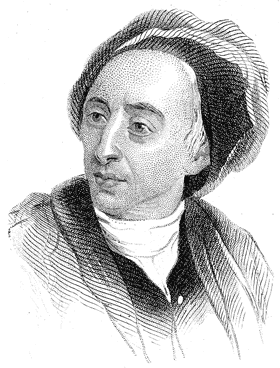 Alexander
Pope (1688-1744)
Alexander
Pope (1688-1744)