 |
|
|
|
|
 |
 |
|
||
|
The Duke of Cumberland, second surviving son of King George II and Queen Caroline, was born at Leicester House at Charing, near London. He spent much of his youth at Midgham House in Berkshire, with his tutor, Stephen Poyntz. At first, Prince William was destined for the Navy, but he preferred the army and saw his first active service under his father at Dettingen. He was wounded there in the leg and, though his wound healed for the time, it caused him trouble all his life. He was not engaged in 1744, but in April 1745 was appointed 'Captain General,' that is to say, practically Commander-in-Chief, of the British Army. During the War of the Austrian Succession, he joined the Dutch-Hanoverian-Austrian forces in Flanders and was, with them, defeated after a most gallant resistance at Fontenoy. The battle was fought in an attempt to relieve Tournay, then besieged by Marshal Saxe. There were no two opinions about the Duke's bravery and activity in this great battle, and the Austrian general, Konigsegg, set a high value on his services; but there were two opinions about the usefulness of his ubiquity on the field. He was recalled to England in October to take over the command against the Jacobite claimant to the throne, ‘Bonnie Prince Charlie,’ who had already occupied Edinburgh and defeated Cope at Prestonpans. Cumberland found his father's army divided: one portion standing fast, to the west of Newcastle, under Wade, the other, from whose command Ligonier had just been invalided, about Lichfield. He took over this corps at the end of November, but allowed the Highlanders to slip past him and to reach Derby while he was moving upon Stone. He seems to have had some fear that they would make a move upon North Wales. When their retreat began, on December 6th, he hurried after them as best he could and managed, with his mounted troopers, to get into an action with their rearguard at Clifton near Penrith. He also recaptured Carlisle. The Duke then returned to London but, on the news that the Jacobites had beaten Hawley at Falkirk, went north again and entered Edinburgh at the end of January 1746. Whoever in England was afraid, 'Billy Cumberland' was not and his appearance at once put heart into the soldiers, who had been thoroughly demoralized by the Highlanders' fierce charges. He advanced to hold the lines, first of the Forth and then of the Tay, and moving up the east coast concentrated at Aberdeen towards the end of February. He spent the next six weeks in gathering supplies and transport, and in training his soldiers to face the claymore. Then, moving always by the coast, he met the Highland Army, whom he outnumbered by nearly two to one, at Culloden, a few miles east of Inverness. When he had won the battle of April 16th, Cumberland gave orders for the systematic extirpation of all 'rebels' who should be found concealed in the Highlands. All houses where they could find shelter were to be burnt and all cattle driven off. This was interpreted to mean the killing or burning of all Highlanders found wounded or with arms in their hands, and Cumberland did nothing to soften such an interpretation of his orders. Hence came his well-known sobriquet of the ' Butcher,' which was given to him in London as early as August. The troops, to whom he entrusted this task of ‘pacification,' consisted not only of English regiments, but also of the Whig clans, themselves in many cases eager to pay off the family feuds of centuries. Cumberland remained in the Highlands till the third week in July superintending the execution of these orders. It must be remembered, if we are to weigh the Duke's character fairly, first, that his general orders show all promiscuous plundering and marauding to have been sternly repressed; secondly, that a campaign in such a country could best be brought to a close, from a military point of view, by a systematic reduction of the people to starvation; and thirdly, that the Jacobites were extremely influential in London and spread many tales of his personal brutality, to none of which credence need now be attached. Probably, if he had not been so corpulent and personally so repulsive, and if his private morals had been better, the name of the ' Butcher' might not have continued to stick to him. Cumberland went to the Low Countries again, in the early spring of 1747, to find that Saxe was already knocking at the gates of the United Provinces and, in July, the Marshal gave the Duke a beating at Lawfeldt, a beating for which the failure, both of Dutch and Austrians, to co-operate was chiefly to blame. After the Peace of 1748, the Duke continued to hold the office of Command-in-Chief and made some useful reforms in the administration of the Army. At least he introduced a stricter system of discipline for the officers, curtailed their leave, reduced their absurd field-equipages and taught them that war was a serious business. But he quite failed to recommend himself to the nation at large. When his elder brother, Prince Frederick, died, people were heard to exclaim, “Oh that it had been the Butcher!” And Parliament, ignoring King George's wish, refused to give him anything more than a seat on that Council of Regency, which was provided by the Bill of 1751 in the event of a demise of the Crown during the minority of the heir. The Duke was still an opponent of Pitt and, when he was sent, in the beginning of 1757, to take command of the Hanoverian Army on the Weser, he insisted on his father's dismissing Pitt before he started. He was beaten, by the French commander D'Estrées, at Hastenbeck, at the end of July, and retreated northwards towards Stade. When he received full powers from his father (who cared only for the safety of his Electorate) to conclude a treaty of neutrality for Hanover. He accordingly concluded the Convention of Klosterzeven, in September, with the new French commander, Richelieu, who had hemmed him in with a force immensely superior to his own. George II, who had unquestionably authorized his son to save Hanover at any price, had the meanness to rate him for doing so and the Convention was disavowed by the British Ministry. Richelieu had himself given some excuse for this action by violating some minor points of its terms. The Duke returned to London and (it must be admitted) bore his position of scapegoat, and his father's treatment, with silent fortitude; but he was obliged to resign his post of Commander-in-Chief. Wolfe described this resignation as a “public calamity”. George III, when he became King, treated his uncle with studied courtesy and, to the dismay of most wise men, consulted him, not only on the appointments of military officers, but also on the formation of his early Ministries. Cumberland was now quite ready to be reconciled to his old antagonist, Pitt, and was successively the enemy of Bute and of George Grenville. The Duke had been made Ranger of Windsor Forest in July 1746, to which Cranbourne Chase was added five years later; and his official residence in England was at 'Cumberland Lodge' in the centre of the Great Park. He had the 'Virginia Water' created nearby from an insignificant stream and took to breading race-horses - amongst them, the famous 'Eclipse' - both at Cranbourne Lodge and at Keate's Gore in East Ilsley. He always lived a profligate life and probably undermined his constitution thereby. He was only in his forty-fifth year when he died, and he had long been ill. It is quite possible to dislike the Duke of Cumberland as a martinet and a tyrant, and yet to admit that he had some qualities that were sorely needed in the service of his day. If his favourite officers were often men of the brutal type of Hawley or Braddock, or of the incapable type of Albemarle, he was also the patron of Wolfe and of Conway; and Ligonier, probably the greatest British commander between Marlborough and Wellington, always believed in him. Mr. Fortescue, however, puts the matter too strongly when he calls him “the ablest man which his family has produced during the two centuries of its reign in England”. Edited from CRL Fletcher's 'Historical Portraits' (1919).
|
|
||
| © Nash Ford Publishing 2001. All Rights Reserved. | |
|||



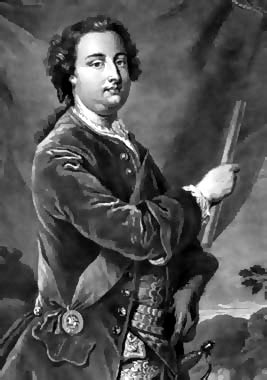 Prince
William Augustus,
Prince
William Augustus,