|
|
|
|
|
 |
 |
|
||
|
 Sir
Edward Norreys (d. 1603) Sir
Edward Norreys (d. 1603)Born: circa 1552 probably at Wytham, Berkshire Governor of Ostend Died: October 1603 at Englefield, Berkshire Sir
Edward Norreys was the third son of Henry
Norreys, Baron Norreys of Rycote. He seems, from an early age, to
have been engaged, like his more distinguished brother John, in military
service abroad. About 1578, with his brothers, John and Henry, he joined the
English volunteers in the Low Countries. In 1584, he was in Ireland. Edward
was elected MP for Abingdon
in 1585, but, in the autumn of that year, he returned to Holland. He took
command of an English company and was soon made lieutenant to Sir Philip
Sidney, who had been appointed Governor of Flushing, one of the towns
temporarily handed over to Queen Elizabeth I as surety by the States
General. Sidney did not arrive till the end of the year and Norreys claimed
to exercise his military prerogatives in his absence. Both Sir Roger
Williams and the English envoy, William Davison, sent to Lord Burghley
bitter complaints of his overbearing temper and of his want of judgment in
the bestowal of patronage (11th November 1585). But, upon Sidney's arrival
in November, he proved compliant. In the following April, the Earl of
Leicester knighted Edward at Utrecht. In May, he took a prominent part in
erecting, on the island where the Rhine and Waal divide at the foot of the
hills of Cleves, the strong earthen fort which is still standing and bears
its original name of Schenken Schanz. On
6th August 1586, Sidney and Norreys arrived in Gertruydenberg to discuss the
military situation with the Governor, Count Hohenlohe, and Sir William
Pelham, the Marshal of the English Army. In the evening, the officers supped
together in Hohenlohe's quarters. Norreys fancied that a remark made by
Pelham was intended to reflect badly upon the character of his brother,
John. He expressed his resentment with irritating volubility and was ordered
by Count Hohenlohe to keep silence. Norreys refused to obey, whereupon the
Count, who was barely sober, ‘hurled a cover of a cup at his face, and cut
him along the forehead.’ Norreys, next morning, challenged his assailant
to a duel and induced Sir Philip Sidney to bear the cartel. Leicester was
informed of the circumstance and began an investigation. He wrote home that
Norreys was always quarrelling with his brother officers and was
jeopardising, by his insolent demeanour, those good relations between the
Dutch and English troops which were essential to the success of the
campaign. The Count declared that no inferior officer was justified in
challenging his superior in command. For the time, the quarrel was patched
up but the ill‑feeling generated by the dispute between the allies was
not easily dissipated. Just before Leicester finally returned to England, in
November 1587, Norreys renewed the challenge to Hohenlohe; but the Count was
ill at Delft and no meeting was arranged. Hohenlohe unreasonably blamed
Leicester for Norreys's persistence in continuing the dispute and reviewed
his own part in the affair in a published tract, entitled
‘Verantwoordinge…..teghens zekere Vertooch ends Remonstrancie by zijne
Excie den Grave van Leycester’. Leicester
left Norreys at Ostend, another town which had been surrendered to the
English by the Dutch in 1580 by way of surety. The English Governor, Sir
John Conway, was absent through 1588 and Norreys acted as his deputy. On
10th June 1588, Sir Edward wrote to Leicester that the town was in a
desperate plight and could hardly stand a siege. In 1589, he accompanied his
brother, John, and Sir Francis Drake on
the Great Expedition to Portugal and was badly wounded in the assault on
Burgos. His life was only saved by the gallantry of his brother. Next year,
in July 1590, Edward was regularly constituted Governor of Ostend. In
December, he received reinforcements and ammunitions from England, in
anticipation of a siege by the Spaniards. In February 1591, he captured
Blankenbergh. But in the April following, he embroiled himself with the
States‑General by levying contributions on the villages of the
neighbourhood. Sir Thomas Bodley, the English envoy, declared his conduct
unjustifiable and Lord Burghley condemned it. Accordingly, Sir Edward was
summoned to London to receive a reprimand from the Council and was ordered
to keep his house. His presence was, however, soon needed at Ostend and he
energetically supervised the building of new fortifications. In 1593, when
the town was believed to be seriously menaced, Elizabeth sent Sir Edward an
encouraging letter in her own hand, addressing him as ‘Ned’. But the
danger passed away and he was at court again in December 1593. The visit was
repeated four years later, when he and Sir Francis were ‘gallantly
followed by such as profess arms’. In September 1599, the Queen recalled
Sir Edward to comfort his parents for the recent loss of three of their sons
and he does not seem to have resumed his post abroad. On
settling again in England, Norreys was granted, by his mother, some small
property at Englefield,
Berkshire, with the manor of Shinfield
and much neighbouring land. Norreys resided at Englefield in a house on the
site of the old rectory which must be distinguished from the chief
mansion in the parish, which was in the occupation of the Paulet
family. Sir Edward married on 17th July 1600 and, in October 1600, he
presented himself to the Queen after his marriage. Dudley Carleton, who had
been in his service as private secretary at Ostend, remained for a time a
member of his household and many references to his domestic affairs appear
in the letters of Carleton's gossiping correspondent, John Chamberlain. On
27th May 1601, Chamberlain wrote that Norreys was dangerously sick. He was
noted "of late," he added, "to make money by all means
possible, as though he had some great enterprise or purchase in his
head". In September 1601, Norreys entertained the Queen to dinner at
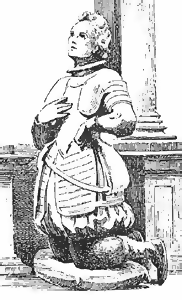
Englefield and Elizabeth was well pleased with the entertainment. The Christmas of 1602, Norreys kept in great state in London, and was ‘much visited by cavaliers’. He died in October 1603 and was buried on the 15th in Englefield Church (being later removed to Rycote Chapel). A statue of him adorns the Norreys monument in Westminster Abbey. His nephew, Francis (later Earl of Berkshire), succeeded to his estates. His wife Elizabeth, by whom he had no issue, was the rich widow of one Webb of Salisbury. She was a distant cousin of his own, being daughter of Sir John and grandaughter of Sir William Norreys, both of Fyfield in Bray and both Controllers of the Works at Windsor Castle. Lady Norreys, after Sir Edward's death, married, in 1604, Thomas Erskine, 1st Viscount Fenton and Earl of Kellie, and, dying on 28th April 1621, was also buried at Englefield. Heavily Edited from Leslie Stephen's 'Dictionary of National Biography' (1889).
|
|
||
| © Nash Ford Publishing 2001. All Rights Reserved. | |
|||