|
|
|
|
|
 |
 |
|
||
|
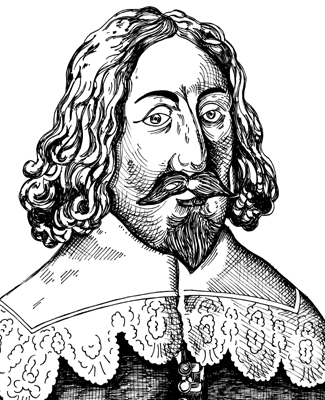 John
Paulet (1598-1675) John
Paulet (1598-1675)Born: 1598, probably at Basing House, Hampshire Marquis of Winchester Died: 5th March 1675 at Englefield House, Berkshire John
Paulet, born in 1598, was the third, but eldest surviving, son of William,
4th Marquis of Winchester (d. 1629) by Lucy (d. 1614), second daughter of
Sir Thomas Cecil, afterwards 2nd Lord Burghley and Earl of Exeter. From 1598
until 1624, he was styled Lord Paulet. He kept terms at Exeter College,
Oxford, but did not matriculate and, on 7th December 1620, was elected MP
for St. Ives, Cornwall. He was summoned to the House of Lords as Baron St.
John on 10th February 1624, became Captain of Netley Castle in 1626 and
succeeded to the Marquisate on 4th February 1629, becoming also keeper of
Pamber Forest, Hampshire. In order to pay off the debts incurred by his
father's lavish hospitality, he passed many years in comparative seclusion.
But on 18th February 1639, he wrote to Secretary Windebank that he
would be quite ready to attend the King on his Scottish expedition 'with
alacrity of heart and in the best equipage his fortunes would
permit'. Winchester
being a Roman Catholic, Basing House, Hampshire, his chief seat - on every
pane of which he had written within a diamond 'Aimez
Loyauté'
- became, at the outbreak of the Civil War, the great resort of the
Queen's friends in South-West England. It occurred to the King's military
advisers that the house might be fortified and garrisoned to much advantage,
as it commanded the main road from the Western Counties to London. The
journal of the Siege of Basing House forms one of the most remarkable
features of the Civil War. It commenced in August 1643, when the whole force
with which Winchester had to defend it, in addition to his own inexperienced
people, amounted only to one hundred musketeers sent to him from Oxford,
on 31st July under the command of Lieutenant-Colonel Peake.
He subsequently received an additional force of 150 men under Colonel
Rawdon.
In this state of comparative weakness, Basing resisted, for more than three
months, the continued attack of the combined Parliamentary troops of
Hampshire and Sussex, commanded by five colonels of reputation.
The Catholics at Oxford successfully
conveyed provisions to Basing under Colonel
Gage. An attempt by Lord Edward Paulet, Winchester's youngest brother, then
serving under him in the house, to betray Basing to the enemy was frustrated
and he was turned out of the garrison. On 11th July 1644, Colonel Morley
summoned Winchester to
surrender. Upon his refusal, the besiegers tried
to batter down the water-house. On 13th July, a shot passed through
Winchester's clothes and, on the 22nd, he was struck by a ball. A second
summons to surrender was sent by Colonel Norton on 2nd September, but was at
once rejected. About 11th September, the garrison was relieved by Colonel
Gage who, being met
by Lieutenant-Colonel Johnson by the Grange, routed Morley's and Norton's
men and entered the house. He left with Winchester one hundred of Colonel
Hawkins' white-coated men and, after taking Basingstoke, sent
provisions to Basing.
Meanwhile,
Winchester, with the white-coats and others under Major Cuffaud and Captain
Hull, drove the besiegers out of Basing. On 14th November, Gage again
arrived at Basing and, on the 17th, the Siege was raised. Norton
was succeeded by a stronger force under the command of Colonel Harvey, which
had no better fortune. At length, Sir William Waller advanced against it at
the head of seven thousand horse and foot.
Still
Winchester contrived to hold out. But after the Battle of Naseby, Cromwell
marched from Winchester upon Basing and, after a most obstinate
conflict, took it by storm on 16th October 1645. Winchester was brought in a
prisoner, with his house flaming around him. He broke out and said
"that if the king had no more ground in England but Basing House, he
would adventure it as he did, and so maintain it to the uttermost,"
comforting himself in this matter "that Basing House was called Loyalty".
Thenceforward, he was called the 'great loyalist.'
What
remained of Basing, which Hugh Peters, after its fall, told the House of
Commons 'would have become an emperor to dwell in,' the Parliamentarians
levelled to the ground, after pillaging it of money, jewels, plate and
household stuff to the value, it is said, of £200,000. Winchester
was committed to the Tower on a charge of high treason on 18th October 1645
and
his
estates were ordered to be sequestered.
An
order was made for allowing him
£5
a week out of his property on 15th January 1646. Lady Winchester, who had
escaped from Basing two days before its fall, was sent to join her husband
in the Tower on 31st January and a weekly sum
of £10,
afterwards increased to £15,
was ordered to be paid her for the support of herself and her children, with
the stipulation that the latter were to be educated as Protestants.
An ordinance for the sale of Winchester's land was passed on 30th October
and, by the Act of 16th July 1651, a portion was sold by the trustees for
the sale of forfeited estates. On 7th Sept 1647, Winchester was allowed to drink the waters at Epsom and stayed there by permission
of Parliament for nearly six months. The House of Lords, on 30th June 1648,
urged the Commons to release him on bail in consideration of his bad health.
In the propositions sent to the King at the Isle of Wight,
on 13th October, it was expressly stipulated that Winchester's name be
excepted from pardon.
Ultimately,
the Commons resolved, on 14th March 1649, not to proceed against him for
high treason; but they ordered him to be detained in prison and excepted
from any composition for his estate. In January 1650, he was a prisoner in
execution in the upper bench for debts amounting to £2,000
and he petitioned Cromwell for relief. The sale of his lands was
discontinued by order of Parliament on 15th March 1660
and, after the Restoration, Winchester received them back. It was proposed,
on 3rd August 1660, to recompense him for his losses to the amount of £19,000
and damages, subsequently reduced to £10,000.
This was agreed to on 2nd July 1661 but, in the event, he was allowed to go
unrecompensed. A bill for confirming an award for settling differences
between him and his eldest son, Charles, in regard to the estates, was
passed in 1663. Winchester
retired to his estate at
Englefield,
Berkshire, which he had acquired by his second marriage, and passed the remainder
of his life in privacy, dividing his time between agriculture and
literature. He greatly enlarged the house, the front of which, says Granger,
bore a beautiful resemblance to a church organ, but 'is now no more' [1775]. Winchester
died at Englefield House
on 5th March 1675, as Premier Marquis of England, and was buried in the
church there. On the monument raised by
his wife to his memory are engraved some fine lines by Dryden. He
was married three times: first, to Jane (d. 1631), eldest daughter of
Thomas, 1st Viscount Savage, by whom he had issue, Charles, his successor,
created 1st Duke
of Bolton in 1689. Milton wrote an epitaph in 1631 upon Jane, Lady
Winchester; and James Howell, who taught her Spanish, has commemorated her
beauty and goodness. Winchester's second wife was Lady Honora de Burgh
(1611-1662), daughter of Richard, 1st Earl of St. Albans and Clanricarde,
who brought him four sons
- of
whom two only, John and Francis, lived to manhood
- and
three
daughters.
By his third wife, Isabella Howard, second daughter of William, 1st Viscount
Stafford, he had no children. Clarendon has celebrated Winchester's goodness, piety and unselfish loyalty in eloquent and just language. Three works, translated from the French by Winchester, are extant: 1. 'Devout Entertainment of a Christian Soule,' by Jacques Hugues Quarré, Paris, 1648, done during his imprisonment in the Tower. 2. 'The Gallery of Heroick Women,' by Pierre Le Moyne, a Jesuit, London, 1652, in praise of which James Howell wrote some lines. 3. 'The Holy History' of Nicholas Talon, London, 1653. To these works Winchester prefixed prefaces, written in simple, unaffected English, and remarkable for their tone of gentle piety. In 1663, Sir Balthazar Gerbier, in dedicating to him a treatise called 'Counsel and advice to all Builders,' takes occasion to commend Englefield (or, as he calls it, 'Henfelde') House. Winchester's portrait has been engraved in a small oval by Hollar. There is also a miniature of him by Peter Oliver, which has been engraved by Cooper, and an equestrian portrait by Adams. Edited from Sidney Lee's 'Dictionary of National Biography' (1895)
|
|
||
| © Nash Ford Publishing 2001 All Rights Reserved. | |
|||