 |
|
|
|
|
 |
 |
|
||
|
Jethro Tull was a major pioneer in the modernization of agriculture. He was a son of Jethro Tull Senior, a gentleman farmer from Bradfield in Berkshire, and his wife, Dorothy, the daughter of Thomas Buckeridge of Wood Green Farm in nearby Upper Basildon. He was born in Basildon, presumably at his grandfather's farm, and was baptised in the parish church there on 30th March 1674, although he grew up in Bradfield and, later, in southern Hungerford. At the age of seventeen, Tull matriculated at Oxford, to St. John's College (the Buckeridges were cousins of its founder), on 7th July 1691, but appears to have taken no degree. He was admitted as a student of Gray's Inn on 11th December 1693; and called to the Bar on 19th May, 1699. In his admission entry, he is stated to be of two years' standing at Staple Inn, and to be the only son and heir apparent of Jethro Tull, by then of Howbery Farm at Crowmarsh Gifford in Oxfordshire, just across the Thames from Wallingford. After being admitted as a barrister, Tull made a tour of Europe and, in every country through which he passed, was a diligent observer of the soil, culture and vegetable productions. On his return to England, he married, in 1699, Susannah Smith, of Burton Dassett (Warwickshire). They settled on his father's farm at Howbery where they were joined by a son and two daughters. Determined to improve agricultural methods and increase yields, Tull pursued a number of agricultural experiments both there. By intense application, vexatious toil, and too frequently exposing himself to the vicissitudes of heat and cold in the open fields, he contracted a pulmonary disorder, which, not being found curable in England, obliged him a second time to travel, and to seek a cure in the milder climates of France and Italy in 1713. He returned, considerably improved in health, but greatly embarrassed in his fortune. Part of his property in Oxfordshire, Tull had sold and, before his departure for the Continent, had settled his family at Prosperous Farm, an estate his father had inherited from a wayward uncle, near Shalbourne, but on the southern edge of Hungerford parish. Two further daughters were born there, one while he was still abroard. Tull revised and rectified all his old instruments at Prosperous and designed new ones suitable to the different soils of his new farm; and demonstrated the good effects of his horse-hoeing culture. But though Tull was successful in demonstrating what might be done by improved culture, he was not able to turn it to his own advantage. His expenses were enhanced in various ways, but chiefly by the stupidity of the workmen employed in constructing his instruments, and in the awkwardness and maliciousness of his servants, who, because they did not or would not comprehend the use of them, seldom failed to break some essential part or other, in order to render them useless. The drill-husbandry had been probably known and practiced for ages; but was first adopted upon a regular and permanent plan by Tull, who professed to have caught the idea from the vine-culture upon the Continent, and to whose ingenious mind the mechanism of an organ suggested the rudiments of an implement for the delivery of seed in drills. "It was named a drill," he says, "because when farmers used to sow their beans and peas into channels or furrows by hand, they called that action drilling" and it could sew three rows of seeds simultaneously. Later, he devised a horse-drawn hoe to clear away weeds Tull became a Bencher of Gray's Inn on 5th May 1724. About this time, he was prevailed upon, by some of the neighbouring gentlemen, who were witnesses of the practical utility of his system, to publish his theory, illustrated by an account of it in practice, which he undertook to do, at no inconsiderable expense, and, at a time too, when he was much harassed in his pecuniary affairs. His first publication was a 'specimen' only, in 1731; which was followed, in 1733, by 'An Essay on Horse-Hoeing Husbandry' folio; which was translated into French by Du Hamel. In the course of thirty years culture of his own grounds under every disadvantage of ruined health and embarrassed circumstances, this enthusiastic genius reduced the tillage, seeding, and weeding of land to a system, which being founded in nature and philosophical truth, no length of time will be able to overturn. For, despite initial resistance to Tull's revolutionary ideas, they were eventually adopted by large landowners and, in time, formed the basis of modern agriculture. Most subsequent drilling and hoeing implements were either copies, or improvements upon the invention of Tull; and his book, in which theory and practice are properly combined, was long in popular esteem. Whatever were his defects, it would probably be difficult to name a man, whose works have conferred a more solid and permanent benefit upon his country. Yet, whilst so many others, for services of a very different nature and tendency, have enjoyed the most splendid rewards, Jethro Tull, whose honest labours were to contribute to the feeding and the employment of countless millions, was suffered to pine out his days in misery and distress. His reward consists in being recognised by posterity as the illustrious 'Father of British Agriculture'. Tull died at Prosperous Farm on 21st February and was buried, in his native village of Basildon, on 9th March, 1741. Edited from 'Stray Notes on Basildon' (19th century) It may be of interest to readers to note that there were two landed families with the surname of Tull in Berkshire. Jethro was from that resident in Midgham for many generations. The other family lived in Streatley for a similarly long period and eventually included the lords of the manor of Crookham in Thatcham parish. As yet I have found no connection between the two despite having traced them to the early 16th and 17th centuries respectively. The Tulls of Crookham evidently believed they were related to the Midgham family as a child in their family was named Jethro during the 19th century.
|
|
||
| © Nash Ford Publishing 2008. All Rights Reserved. | |
|||



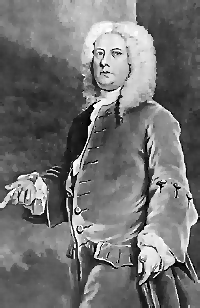 Jethro Tull (1674-1741)