|
|
|
|
||
 |
 |
|
|||
|
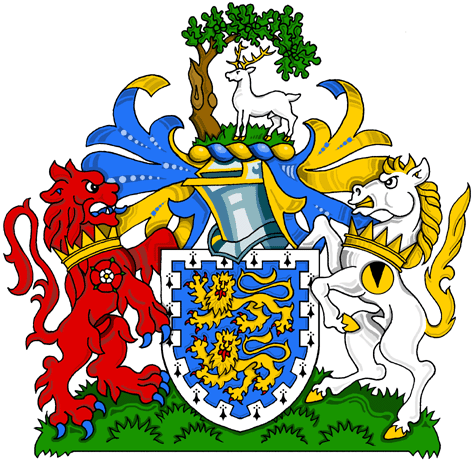
The coat of arms of Berkshire were granted on 18th July 1947 and the supporters on 7th April 1961. Heraldically, they are described as follows:
Berkshire
is a Royal County, and the two lions on her coat of arms are derived from the
arms attributed to the Norman kings with whom the county has close associations.
William the Conqueror was often in residence at Windsor Castle and his son, King
Henry I, founded and was buried at Reading Abbey. This privilege is unique among
shire counties. The embattled border, of Royal ermine, refers to the Royal
castles in the County, notably at Windsor & Wallingford. The
crest is based on an old County emblem alluding, not merely to the forestlands
which gave Royal sport to the Saxon and Norman kings, but specifically to the
legend of the Royal huntsman, Herne the
Hunter. The oak tree is the one on which he hanged himself, in the late
14th century, before it was struck by lightning. The white hart is one of the
manifestations of his restless spirit. It is a variation of the Old Berkshire
badge used at one time by the Royal Berkshire Militia and, according to
Drayton's poem of 1627, a banner with this badge, or something very like it, was
carried by the men of Berkshire at the Battle of Agincourt. The
supporter of the shield on the left-hand side is a red lion collared with a
golden ancient crown, emphasising the fact that Berkshire is a Royal county. The
lion has, depicted on its shoulder, a Tudor rose, joining the red rose of
Lancaster and the white rose of York. This is a reference to Windsor Castle
where the leading monarchs of both factions are buried. The
supporter on the right is a white horse, also with an ancient crown in gold as a
collar, hanging from which, a gold disc is shown with a black wedge, point
downwards. The white horse refers, of course, to the ancient White Horse at
Uffington and the lovely Vale of the White Horse. The wedge, heraldically a
"pile," is a punning reference to the atomic energy pile, at Harwell.
Taken together, the white horse and the wedge are reminders of the ancient and
modern aspects of the Royal county. Because the arms were officially granted to the Berkshire County Council and not actually to the county itself, they were altered slightly with the reorganisation of the administrative county boundaries in 1974 (largely the replacement of the white horse with a black one) and, since the council's demise in 1998, officially the county has no arms at all. Attempts to transfer the old arms to the Lord Lieutenancy have, so far, been unsuccessful. The Flag
of Berkshire
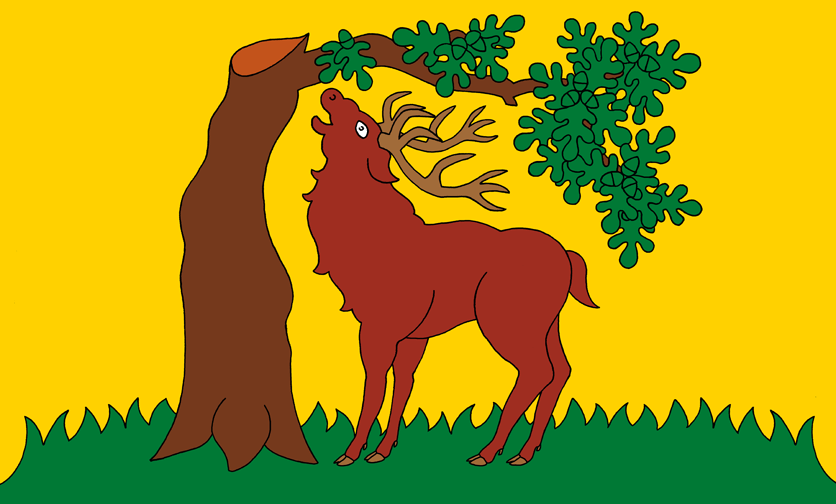
As of 27th February 2017, Berkshire has a flag registered with the Flag Institute. The old county council occasionally used a stylised monochrome version of the two lions under a crown. However organisations in the county have always used the white hart (or brown stag) beneath its oak, as supposedly used by the Berkshire men fighting at the Battle of Agincourt as recorded in Michael Drayton’s poem of 1627. It may be seen in logos and flags of various designs and colours, such as those of:
(Having been approached by a number of organisations concerning the lack of a flag for the county, RBH offered up a design in 2006 which was available for sale and adopted by a few organisations, but it faced critisim from flag circles unfamiliar with the county and its traditions. It was loosely based on the Welsh National flag and the Buckinghamshire arms, which both have animals before two coloured bands (although Buckinghamshire's are vertical). Both these designs broke the heraldic rule of having metal on metal or colour on colour, something which was deemed unacceptable on our Berkshire design. Our horizontal background banded colours of blue and white were taken from the old county arms, but are also used by Reading Football Club, and represented the River Thames and the county's chalk hills. The circular form of the golden deer and oak on top of these is a traditional form used by both the Royal Berkshire Regiment and the Berkshire Federation of Women's Institutes, but again was considered to look too much like a 'C' to be used for Berkshire. The colour of gold on blue (and white) was again mirrored from the old arms and represented Royalty as well as the Autumn colours of the oak illuminated by a lightning strike. An alternative version, with white hart on a blue background only and under a golden oak tree without the traditional lightning strike damage was later put forward by Michael Garber.) Brady Ells has suggested a version of the traditional stag under the lightning struck oak tree in natural colours upon a golden background, as used by Berkshire County Council (on a shield) prior to being granted their official coat of arms. As a traditional versions already in use by the county, supported by a large selection of Berkshire-based organisations as well as the Lord Lieutenant, this has been accepted by and registered with the Flag Institute. See its official page here: www.flaginstitute.org/wp/flags/berkshire The above illustrated version of the new flag has been released into the public domain by NFP & RBH. Fly the Flag of Berkshire with pride! Download large graphic of the Flag of Berkshire.
|
|
|||
| © Nash Ford Publishing 2006; revised 2017. All Rights Reserved. |  |
||||