|
|
|
|
|
 |
 |
|
||
|
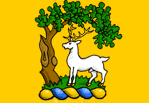
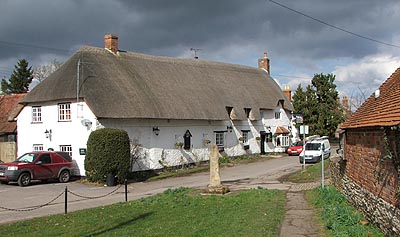 Denchworth DenchworthHydes & Fettiplaces This unfortunate name means 'Dunce’s Farm'. The village is actually South Denchworth. One of the local manors was the original home of the prolific Hyde family of Berkshire. Their name stems from the Hide of Southcote: 'Hide' was the area of land that the manor comprised near the larger manor of 'Southcote' (or Circourt). It was supposedly given to them by King Canute. There was once a considerable village at Circourt, but it became deserted after the Black Death decimated the population in the mid-14th century. It was probably around this time that the family moved their home to the very north of the parish, to Hyde Farm. They later purchased all the manors in the parish and settled at Denchworth Manor, next to the church, where three sides of the medieval moat remain. Another moat nearby may have been where the famous Fettiplace family came from, ie. North Denchworth (See West Hanney). The two families had the same coat of arms, and, back in the mists of time when surnames first emerged, they were probably the same family. The Hydes sold up in 1617. They have a fine set of family brasses in the church including members of the family who died in the 1940s. The most fascinating memorial in the collection is that to William Hyde who died in 1557. He must have been a man with a shrewd eye for a bargain, for he appears to have picked up the brass plate cheap at the Dissolution of the Monasteries. When the church was restored, last century, his brass memorial was removed from its stone to the chancel wall. It was found to be a palimsest, for on the back was found a very important inscription in French: King
Edward of England, Thus showing that William had gone shopping at Bisham Priory. It is an extraordinary survival. Above the church porch was a small chamber, built in 1693 by the vicar, Ralph Kedden, to house his chained library of over a hundred books. They included The Golden Legend printed by Caxton in 1483! The books were supposed to be preserved in trust by the vicar for his successors forever; but the porch was soon pulled down and the books taken to the vicarage. Few now remain: the Caxton was sold to the Bodleian. There was also a small collection of curiosities, amongst them the rib of a mermaid (or manatee). Denchworth parish has a clay based soil for the most part and it has, thus, always more suitable for pasture than arable production. With the introduction of new fodder crops, such as clover and beans, in the early 19th century, farmers were able to keep larger herds of cattle over the winter and high quality Denchworth fodder beans were subsequently in great demand throughout the country. Dairying too was undertaken on a larger scale, after the parish has been enclosed and, as early as 1730, Richard Willman of Circourt had become one of the biggest cheese producers in Berkshire, a tradition which continued for many decades.
|
|
||
| © Nash Ford Publishing 2001. All Rights Reserved. This location is now administered by Oxfordshire County Council. | |
|||