 |
|
|
|
|
 |
 |
|
||
|
Most of the Roman activity from Lambourn
parish appears to have been in the Eastbury area. A highly interesting
find is a bronze sceptre head in the form of a male bust. It may have
been associated with a Roman temple whose whereabouts is, as yet,
unknown. Perhaps it was the building on Stancombe Down, revealed by
its roof tiles and floor tesserae; pottery, mortars and coins.
Although this is usually interpreted as a villa. The graves of ten 4th
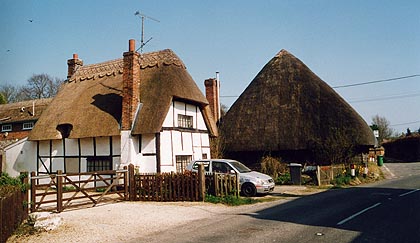
century residents have also been found there. Eastbury must be one of the prettiest
villages in Berkshire. It has many old and interesting buildings which
catch the eye as you pass along the Newbury to Lambourn road. There are
huge medieval thatched barns, little cottages and Jacobean farmhouses.
Pigeon House Farm is named after its well preserved flint and brick
dovecote with room for 999 pigeons! Both buildings are dated 1620. The
red-brick manor is also 17th century and features internal panelling and
a fine chimneypiece flanked by caryatids. As his name suggests, the family of the
great Lambourn benefactor, John
Estbury, who built the village
almshouses, came from Eastbury Manor. His ancestor and namesake acquired
it through a number of land transactions in the 1360s, during the lunacy
of the rightful owner, Joan de Wanting! The little church of St. James only dates
from 1851, but the village has a medieval preaching cross. In the 16th
century, it was stated that "on Wednesday in the procession week
the procession of Esbery goes to Gombelton Cross and meets Lamborne
procession and then both come to Esbery chapel. . . . Then Esbery goes
with them in to the Wodlond on Holy Thursday and the procession of
Esbery goes to Wodebery Crosse and there tarries for Lamborne's
procession."
|
|
||
| © Nash Ford Publishing 2004. All Rights Reserved. | |
|||



 Eastbury