|
|
|
|
|
 |
 |
|
||
|
Just west of the village, an interesting 4th century Roman bathhouse has been discovered. Roman bathing was a lengthy process taking the bather through several sauna rooms of differing temperatures. The Kintbury building consisted of a large hypocaust heated tepidarium or warm room with two smaller annexes: an unheated frigidarium (cold room) which may have held a swimming pool-like tank for plunging and the typical apsidal caldarium or hot room. An attached villa complex may lie undiscovered nearby. The name comes from Saxon Kennet-Byrig meaning ‘Fort on the River Kennet’. Kennet is, however, of Celtic origin, Cuno-etio, the same as the Roman settlement at Mildenhall (Wilts): possibly ‘Dog River’ though the reasoning is quite obscure. The lost fort may be represented by the modern 'Forbury'. Many years ago a number of skeletons were dug up near the churchyard and more recent excavations have revealed a number of late Saxon pits, postholes and gullies in the same area. One pit contained an unusual deposit of two disarticulated skulls, long bones and a pelvis! There were also some nice domestic finds, such as a Saxon bone comb. All this may indicate the whereabouts of the Holy Place (probably a monastery) mentioned in the will of Thegn Wulfgar in AD 931. He owned the village of Inkpen which he left to “the servants of God at Kentbury and the Holy Place there”. The church was certainly a Saxon Minster, and the village may have been a Royal Estate. After the Conquest, Kintbury became one of Berkshire’s proto-towns and, in 1267, was granted the right to hold a weekly market and two three-day fairs on the feast days of the Virgin Mary and SS. Simon & Jude each year. Unfortunately, the village was eclipsed by nearby Hungerford in later centuries. The parish church, which is also dedicated to the Virgin Mary, dates from shortly after the Norman Conquest, and the bulk of the building (nave and chancel) dates from this time. The tower is slightly later (circa 1195) but also has a fine 15th century chequered addition to its upper levels. Legend says the previous belfry was blown down in a storm. The ‘Kintbury Great Bell’ fell into the river and was prevented from being restored by the local witch! Inside the church are a number of imposing 18th century monuments to the Jemmett and Raymond families, featuring busts of the deceased. Phillip Jemmett, a London brewer, purchased the mansion of Barton Court in 1665 and his descendants, the Raymond and Dundas families, including Lord Amesbury, lived there until 1832. Barton Court was one of the nine manors into which the parish is divided. Seven of them are mentioned in the Domesday Survey. Barton is more properly known as Kintbury-Amesbury because, in the middle ages, it was owned by nuns of Amesbury Abbey in Wiltshire. The land had been given to them by the wicked Queen Aelfthrith in recompense for the murder of her step-son, King Edward the Martyr. It covers the land north of the River Kennet. South of the river is Kintbury-Eaton, similarly owned by nuns of Nuneaton Priory in Warwickshire, where, in Saxon times, the Sheriff of Berkshire kept his horses. Of the five lesser manors, Denford (Danes' Ford) is said to have been where the Danes crossed the Kennet on their way to fight King Alfred at the Battle of Edington, although this was probably in Wiltshire rather than nearby Hungerford. Denford House was built for William Hallett in about 1810. It was later sold to the Cherry family, whose most famous son was Captain Scott's companion, Apsley Cherry-Garrard. Along with Inglewood, it is recorded by name in the Domesday Survey. The ‘English Wood’ is now represented by Inglewood Park, one time home of the Blandys and the Dunns. Three sub-manors were carved out of Inglewood. Balsdon (alias Belletston or Inglewood Bellet) is sometimes referred to as a castle. The building has long gone, but a fine triple moat remains. It was a secondary manor of the Darell family from Littlecote Park. Though the infamous 'Wild Will Darell' lost his interest there during his lifetime and it was probably at Barton Court that he died after being obliged to give up Littlecote in order to pay for his crimes. He has a painted memorial in Kintbury parish church where he was buried in 1588. Anville’s Manor (alias Godingwood) also has an irregular moat, in Hightree Copse south of the present farm. Templeton (alias Temple Inglewood) was granted to the soldier-monks known as the Knights Templar by the Count of Meulan around 1088. Their main Berkshire residence was at Bisham Abbey. Titcombe Manor is interesting for it was held from the King in return for keeping one of his hawks. The manor of Wallingtons, like the hamlet of Wawcott, indicates a very ancient site inhabited by the Romano-British or 'Welsh' as the Saxons called them. The present house, south-west of the village, is early 17th century but was greatly altered by the Victorians.
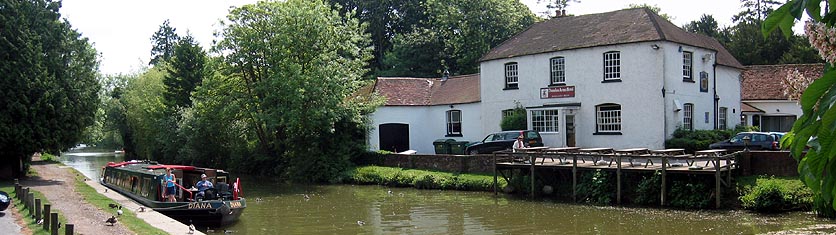
Between 1794 and 1798, Kintbury was transformed as ‘navvies’ filled the village during the construction of the local stretch of the Kennet & Avon Canal. It was around this time that Rev. Fulwar Craven Fowle was the incumbent of Kintbury. A relative of the Earl of Craven from nearby Hamstead Marshall Park, he is said to have been described by George III as “the best preacher and the best rider to hounds in my whole County of Berkshire”. However, he is chiefly famous for his brother having once been engaged to Jane Austen’s sister, Cassandra. The famous authoress was a distant relative and wrote several times, in her letters, of visits to Kintbury, describing how the village was "famous for its apples". She stayed both at the old vicarage and at Croft Cottage, the home of Mrs. Dexter, the vicar's daughter. Her last visit was in 1816, a year before she died. There are said to be tunnels, once used by highwaymen, that connect the church to the Blue Ball Inn. This old pub was the headquarters of the agricultural disturbances of the early nineteenth century known as the Machine or Kintbury Riots. A mad rabble paraded through Western Berkshire for several days, protesting at the lack of work and smashing farm machinery as they went. They were eventually besieged in Kintbury village and finally rounded up by Col. Charles Dundas MP of Barton Court and Lord Craven and their men. Most of the leaders were discovered at the Blue Ball, some also at the Red Lion. One man is said to have escaped by hiding in the former inn ’s huge copper! The rest were sentenced to death, but, all but one, were later reprieved and transported for life instead. The grave of the hanged man, William Winterbourne, was discovered on the south-west side of the churchyard in 1984. Although agriculture was obviously the main occupation of Kintbury's inhabitants, milling was also important. Three water mills are mentioned in the Domesday Survey of 1086 and there are numerous records of mills in the various manors over the centuries: most were for corn, though Denford had a fulling mill as early as 1349 and there was a silk mill in the village in the 19th century. Chalk quarrying for the whiting industry was also undertaken right up until the 1960s.
|
|
||
| © Nash Ford Publishing 2004. All Rights Reserved. | |
|||



 Kintbury