|
|
|
|
||||||
 |
 |
|
|||||||
|
The 16th century antiquary, John Leland, stated that Maidenhead was known as Alaunodunum in Roman times. His dubious source is unknown and the only evidence of Roman occupation in the town is a couple of rural villas. One on Castle Hill was extensively excavated in the 19th century, but better known is that at Cox Green uncovered on the town’s southern edge in 1959. In the 9th century, the invading Vikings are said to have disembarked from their longboats at Maidenhead and fought their way through to Reading, which they subsequently made their operational base in the South of England. At this time, what is now the centre of the town was known as South Ellington (possibly the origin of Leland’s erroneous Latin name), on what was soon to become the border of the parishes of Bray and Cookham. It was when this little hamlet merged with its Maiden-Hythe or New Wharf, at the nearby Thames crossing, that the name changed. The origins of the name are not necessarily that simple however. Hithe is usually accepted as Anglo-Saxon for wharf, but there are many alternative explanations available for the maiden part:
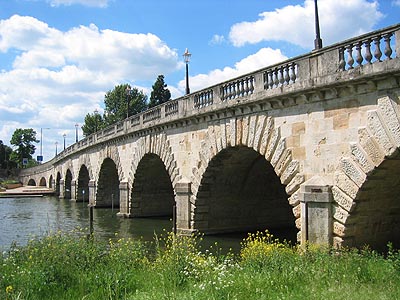
If the name really relates to ‘maidens’ rather than ‘new,’ then these would presumably be the nuns from nearby Cookham. It is supposed that any fort or cauldron-shaped remains would have stood on Castle Hill or perhaps at Cliveden. Castle Hill was originally known as Folly Hill, perhaps indicating the site of a tree-covered earthwork. However, it is more likely that the ruins of the Roman villa discovered there were first referred to as the ‘folly’ that gave the hill its name. In the 17th century, a building called Cook’s Folly did stand near the Windsor Castle Inn (supposedly named after its view). This place was previously called the Fleece or Folly Inn and it is presumed that both the pub and the hill were renamed around the same time. The name was the inspiration for a later Castle Folly built through a whim of a local draper, Edwin Hewitt, in 1897 and still to be seen today. Another folly in the town was Langton’s Folly which stood on the site of the Magnet Leisure Centre. Representing the ruinous façade of a Norman church, it was built by a group of vagrants for a local brewer who wanted to obscure the view of his malthouse. Langton’s Brewery was in Market Street. In 1269, an old chapel was built at the end of Chapel Arches (aka Moor Bridge) over the York Stream (formerly Wid Brook) in Maidenhead, without ecclesiastical permission. The medieval chapel stood empty for fifty years until the Bishop of Salisbury finally allowed its use. The chapel became a stopping place for travellers praying for a safe journey and for pilgrims visiting the maiden’s head after whom the town was then thought to have been named. This was said to be the skull of one of the eleven thousand virgin followers of St Ursula of Cornwall who, according to tradition, were martyred at Cologne in the 4th century. Other supposed relics of St Ursula’s followers were held at St George's Chapel, Windsor. The young Maidenhead girl was long thought to have been represented on the 14th century town seal, but this is actually St John the Baptist. In reality, the town has no known connection with St Ursula, who may not even have existed. The chapel was rebuilt in 1726 but, a hundred years later, it was regarded as obstructing traffic and was torn down. Metal studs and a plaque in the pavement outside the current Bear Inn still mark where the old chapel once stood. A new church was built to the north-west. Further east is the famous Maidenhead Bridge. This was originally a wooden structure built in about 1280 to replace a ferry at an important crossing point of the Thames along the Saltway from Droitwich to London. It was once much longer and the parishes of Cookham, Bray and Taplow met under the central arch. There was a hermitage at the Maidenhead end and the hermit there collected offerings to maintain the crossing. In 1400, during the Epiphany Rising, the Earl of Salisbury from Bisham Abbey tried unsuccessfully to assassinate King Henry IV at Windsor and restore Richard II to the Throne. He had to flee first to Sonning and then to Reading. His followers tried to buy him some time by holding Maidenhead Bridge. They had a pitched battle with the royal forces for three days but were eventually overcome and the Earl captured and executed. The bridge was broken down during the Civil War to limit troop movements. Fifty years later, during the Glorious Revolution of 1688, the rebuilt river crossing was almost the scene of more fighting. When the Irish soldiers of the Catholic King James II were retreating from Reading, they stopped at Maidenhead with a view to holding the bridge against the Protestant champion, William of Orange (later King William III). They set up gun emplacements and fortified a brick house in the town, but the Irishmen could not match William’s Dutch army, who sent in drummers under the cover of night to sound a retreat. In the confusion, the Catholics quickly withdrew to London. The present bridge at Maidenhead was built in stone for Sir Robert Taylor in 1772, when tolls were introduced which continued until 1903. It was the bridge at Maidenhead that brought prosperity to medieval South Ellington and its Maidenhithe wharf. Travellers found it a convenient stopping place and inns providing accommodation soon began to appear. One well-known ancient inn became the scene of an event of national importance during the Civil War. After King Charles I’s capture by Parliament, he was held prisoner at Caversham Park, but was allowed a trip to Maidenhead to visit his youngest children at the Greyhound Inn. The townsfolk strew his route with flowers and Lord Fairfax, the Parliamentary commander, found the meeting so touching that he allowed the little Royals to return with their father to Caversham. The Greyhound finally burnt down in 1735 and a bank now stands on the site where a plaque records King Charles’ visit.
The railway arrived in Maidenhead in 1838, although the first stations were at Taplow and Boyne Hill, the present station only being built in 1871. The famous brick Railway Bridge over the Thames was erected by Isambard Kingdom Brunel in 1839. It has only two arches, each spanning a vast 128 feet. The right-hand one has an amazing echo and is thus known as the ‘Sounding Arch’. When built, these arches were the widest and flattest in the World and an old story tells how the Great Western Railway did not believe they would hold up. They therefore insisted that the wooden construction framework be left in place. However – in imitation of James Bedborough’s work at Windsor – Brunel lowered these temporary works so that, while appearing to support the main structure, they were actually useless. Eventually, a flood washed them away, the bridge stood alone and Brunel’s true genius was revealed. The bridge is the subject of the first ever impressionist painting, JMW Turner’s ‘Rain, Steam and Speed’ (1844). Read more history of
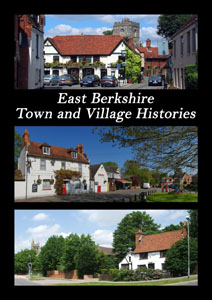
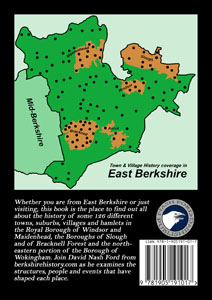
Maidenhead and its suburbs in David Nash Ford's book, 'East Berkshire Town and Village
Histories'.
Click for the Maidenhead
Stop on the Berkshire Towns
Tour
|
|
|||||||
| © Nash Ford Publishing 2001; Revised 2020. All Rights Reserved. | |
||||||||



 Maidenhead
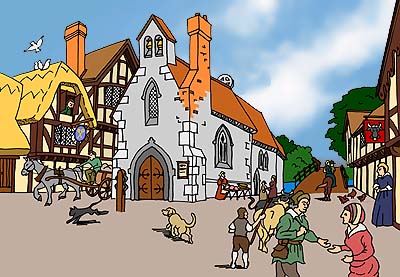
 In the 18th century, as the second stop on the popular Bath Road out of London (before Slough was fully developed), Maidenhead was one of the busiest coaching stops in the country. Ninety coaches a day passed through the town. The coaching inns were highly popular, especially at dusk, when coachmen refused to carry on over the infamous Maidenhead Thicket for fear of being held up by highwaymen. An old story tells of how the ostler at the now demolished Sun Inn used to moonlight as a man-of-the-road. He would rob the coaches on the Thicket and then comfort the distraught passengers when they arrived at the inn. The Sun could hold up to forty horses in its stables, including extra cock-horses used to pull coaches up Castle Hill. The White Hart could take fifty horses.