|
|
|
 Royal Visits Royal Visits
to
Reading
in Tudor Times
Although after 1540 there was no
longer an Abbot
of Reading, many Royal visits to Reading
took place in the sixteenth century. King Henry VIII made use of the
Abbey buildings as a palace, and part of the old Hospital
of St. John was used by him and his successors as stables for
the Royal horses. In the time of Elizabeth, part of the Abbey
was known as the 'Queen's House'. Meanwhile, the estates of the monks
were given away to courtiers and some of the Abbey buildings were pulled
down. Even the bridges and streets of Reading were repaired with the
stones of Henry's Abbey.
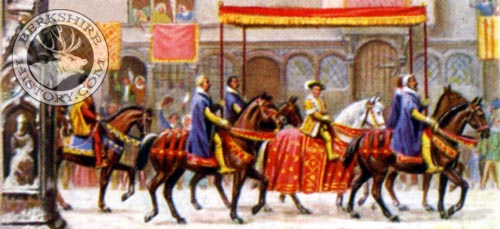
In 1552, the young King Edward VI came to Reading. We still have an
account, written down at the time, telling us how he was received. He
was met at Coley Cross by Thomas Aldworth, the Mayor, and many of the
people of Reading in their best apparel. As the King rode up, the Mayor,
on his knees, welcomed him to the town. Then the Mayor took his mace and
kissed it and, in token of submission, handed it to the King who gently
put it back into his hand again. The Mayor then mounted his horse and
rode before the King through the town, and so led him to the palace at
the Abbey. This was the first time that Edward VI had visited Reading
and the Mayor thought it would be proper to offer him a present. The
present consisted of two yokes of oxen. They cost £16 and were paid for
by the burgesses. The Mayor and burgesses also felt that politeness
required them to present gifts of money to the King's heralds, his
sergeants-at-arms, his trumpeters, his cup-bearer, his footmen and the
other officers in waiting on him.
King Edward died the following year. In July, 1554, Queen Mary and her
consort, Philip II of Spain, passed through Reading. They had come from
Winchester, where their marriage had taken place in the Cathedral. The
English people were not particularly pleased about this marriage of
their Queen with a foreign king; but still the Reading burgesses behaved
to her with loyal courtesy. Robert Bowyer was then Mayor. Accompanied by
the chief burgesses in brave apparel, he met the Queen and her husband
at the upper end of Sivier (Silver) Street, just where the Winchester
(or Southampton) Road descends from Whitley Hill towards the town. As
before, the Mayor knelt in loyal homage, handed to the Queen the mace
and, from her hands, received it again. Again, he rode before his
Sovereign, bearing the mace in his hand, and so he led them to the
palace at the Abbey. He presented them with "four great fat
oxen" and, again, the officers of the Court received presents from
the burgesses.
Queen Elizabeth visited on least six occasions (1568, 1572, 1575, 1592,
1602 & 1603), staying with Sir
Francis Knollys, to whom she had leased the old Palace or 'Abbey
House' as it became known. So often was she in the town that, in
1575, she caused a seat to be made for her in the chancel of St.
Lawrence's Church. This seat had a fine canopy above it and was called
the 'State.' When she visited the church, the floor was strewn with
flowers and rushes. On the occasion of her visit in 1602, she dined at Caversham
House, where the Earl of Banbury, the Controller of her Household,
resided. Queen Elizabeth took much interest in Reading. In 1560, she
granted to the Corporation a new charter, greatly enlarging their powers
and privileges. It was she who sent a large number of mulberry trees to
Reading in order to encourage the industry of silk-weaving.
From WM Childs'
"The Story of the Town of Reading" (1905)
|
 |