|
|
|
|
|
 |
 |
|
||
|
The
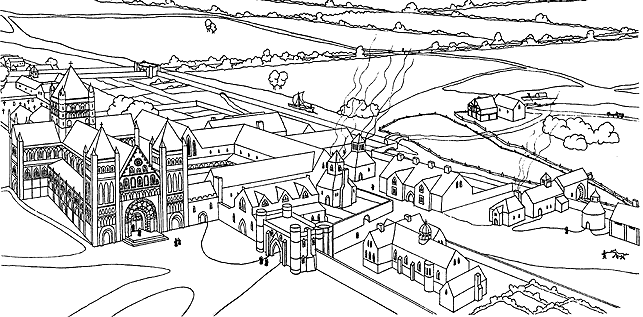
Abbey of Reading, dedicated to the Virgin and St. John the Evangelist, was
founded by King Henry I in June
1121, on a site between the rivers of Thames (on the north) and Kennet (on
the south), much nearer to the latter. The Abbey was of the Cluniac Order.
The Cluniacs were the first of several orders founded with the object of
keeping more strictly the Rule of St. Benedict. They date back as far as AD
912. A distinguishing mark of the Order was that all its houses were
directly subject to the one mother-house of Cluny (near Macon). The Abbot of
Cluny nominated the superior of every subordinate house and, to him, they
all owed allegiance. The first Cluniac priory founded in England was at
Barnstaple. It never became important. The next, that of St. Pancras at
Lewes, set up in 1077, was the senior house in England. All the English
Cluniac monasteries were priories except Reading and Bermondsey. There were
thirty-two of them still existing at the Dissolution. Reading,
however, did not long remain Cluniac. In the course of the thirteenth
century, we find it mentioned as simply Benedictine; and Benedictine it
remained. The exact date of this change does not seem to be known. Henry
I had been a benefactor to the mother-church of Cluny and it is therefore
not surprising to find him encouraging the Order at home. He endowed Reading
very richly and colonised it with monks from Lewes and Cluny. His charter of
1125 begins with the statement that there were three abbeys in England which
had been done away with because of their sins, that is Reading, Chelsea and
Leominster. "He will now refound Reading and give to it the possessions
of the other two." William of Malmesbury confirms this statement by
saying that there was once a nunnery at Reading, long since abolished. The
charter once granted, building proceeded steadily. When Henry died (at
Bois-Lion, near Rouen) in 1135 and was brought to England. The church was
far enough advanced for him to be buried in front of the high altar. But not
till 1164, was church was finally consecrated. This was done by the
Archbishop Thomas A’Becket, in the presence of Henry II and many nobles. The
only important addition made to the church seems to have been that of the
Lady Chapel, which was added at the extreme east end (the usual place) in
1314. Of the other buildings of the Abbey, we have really no history. Among
the many events of more or less interest which are bound up with the Abbey,
one of the most brilliant was the wedding of John of Gaunt with Blanche,
daughter of Henry Plantagenet, Duke of Lancaster, on 19th May 1359. An
earlier one, which may also stir the imagination, was the visit of Heraclius,
Patriarch of Jerusalem, to King Henry II in 1185. The Patriarch
earnestly besought the King to rescue the Holy Land from Moslem domination
and would have had him accept the Kingship of Jerusalem; but Henry was not
to he moved and the Patriarch went away disappointed. The
Suppression was as evilly carried out as that of Glastonbury. Hugh
Cook of Faringdon, the last Abbot, though a friend of the
King and, so far as can be gathered, a wholly upright and very courageous
man, was executed as a traitor in 1539 outside Reading Abbey’s inner
gateway. His real offence was that he would not acknowledge the King's
supremacy in other than temporal matters, and would not voluntarily
surrender his Abbey. In 1895, he, with his fellow-sufferers of Glastonbury
and Colchester, was beatified by the Roman Pontiff. The Abbey fell to the
King and the expelled monks were not even pensioned until Queen Mary's
reign. The annual value at the Suppression was somewhat over £2,000. Not much harm befell the church in the time of King Henry VIII, who made part of the monastic buildings – probably the Abbot’s House - into a Royal Palace, which was used now and again by the next three sovereigns. During Queen Elizabeth's reign, the place was leased to Sir Francis Knollys and his wife, the Queen's cousin. It became their town house - Abbey House - and Elizabeth visited often. In 1550, Edward VI had granted the Abbey Church (as he did Glastonbury) to Protector Somerset, on whose name be anything but peace. The parish church of St. Mary in Reading was rebuilt and, to provide material, the choir was taken down. In the course of this, Henry I's tomb was broken up and his bones scattered. Later, the Poor Knights' Lodgings at Windsor Castle were built of the spoils of the Lady Chapel and, in 1643, when the Parliament besieged the town, the construction of defensive works involved the stripping out of most of the nave. The tale of destruction could be lengthened, but shall not. Edited from MR James' "Abbeys" (1925)
|
|
||
| © Nash Ford Publishing 2001. All Rights Reserved. | |
|||