|
|
|
|
|
 |
 |
|
||
|
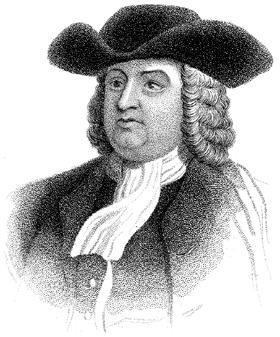 William
Penn (1644-1718) William
Penn (1644-1718)Born: 1644 at Great Tower Street, London Governor of Pennsylvania Died: 1718 at Ruscombe, Berkshire William
Penn was the son of Sir William Penn Senior, an admiral, who figures in
Pepys' Diary. He was born on the
east side of Great Tower Street in London and baptized in the Church of All
Hallows, Barking (Essex), where there is a memorial tablet. In 1660, he went
to Christ Church College, Oxford. There, his protests against the prejudices
manifested against puritans and his interest in the Quakers brought upon him
the disapprobation of the authorities, and of his father. In 1662, after
becoming a member of Lincoln's Inn, he was sent abroad. Returning
in 1667, Penn became a leader in the Society of Friends and engaged in
controversial writing. For a pamphlet, A Sandy Foundation Shaken, in
which the doctrine of the Trinity was assailed. he was arrested under
the Blasphemy Act and committed to the Tower of London in December 1668. He
was told he must recant or remain there for life and Stillingfleet (then
rector of St. Andrew's, Holborn; afterwards Bishop of Worcester) was sent to
remonstrate with him. Penn said to him: "The Tower is to me the worst
argument in the World. My prison shall be my grave before I will budge a
jot." In July, 1669, through the intervention of James, Duke of York,
he was released, having written whilst a prisoner his book, No
Cross, No Crown.
In 1670, he was tried at the Old Bailey for preaching in the streets, the
charge being one of conspiring to address and addressing a tumultuous
assembly. He pleaded “not guilty" and disputed the legality of the
indictment. Notwithstanding that great pressure was brought to bear upon
them by the Bench, the jury, after a trial lasting four days, acquitted
Penn. He, however, went to gaol in default of paying a fine imposed for not
removing his hat in court. The jury were also committed to prison. A tablet
in the Central Criminal Court commemorates this event. In 1672,
Penn was preaching in Holland and Germany. In 1675, he began his connection
with America. He was appointed trustee of the shares of a bankrupt Quaker
who owned half the lease granted to the colonists of New Jersey. He then
helped to form the Quaker Colony of West New Jersey and, in 1676, "drew
up its constitution or 'concessions', remarkable for its democratic nature
and claim for complete religious toleration". In 1677, he again
travelled through Holland and Germany. In 1680, in
despair of securing real religious toleration in Europe, Penn began the
negotiations for the creation of a Quaker settlement in America. An area of
land, north of Maryland and west of the Delaware River, was granted to him
by Charles II. To it he gave the name of Sylvania, which was altered at the
Royal command to Pennsylvania, in honour of Penn's father. Penn was named
governor of the province and set sail in 1682. "On arrival, he convened
the Assembly, which accepted the constitution, the chief feature of which
was complete religious freedom; founded and named Philadelphia; and made a
treaty of friendship with the Indians." The last of this brief epitome
of achievements has always been a classical example for pacifist propaganda
though, regrettably, there is little analogy here with the problem of modern
statecraft. After two years spent in organization and negotiation, Penn
returned to England. Penn was a close friend of King James
II and thus managed to secure the release of many Quakers from prison. He
was partly responsible for the Declaration of Indulgence which sent the
famous ‘Seven Bishops’ to the Tower of London. The Glorious Revolution,
therefore, made him a suspected person and he was forced to live in
retirement. He was present, in 1690, at the
funeral of George Fox at the Bunhill Fields Burial Ground and narrowly
escaped arrest. His last years were unhappy. His principles were flouted in
Pennsylvania and, from 1692-4, he was deprived of his powers as governor. In
London, he lived in poverty for some time in Norfolk Street off the Strand.
"It was the last house on the south-west corner," writes G. H.
Cunningham, "with a peephole in the door, through which Penn carefully
scrutinized visitors before admitting them. Hawkins says that the house was
chosen for its convenience in getting away by water for, at the time Penn
lived here, he was in bad financial circumstances and was trying to avoid
his creditors." He died at Ruscombe House (since demolished), near Twyford, in Berkshire where he had lived since 1710 and was buried in the Quaker Graveyard at Jordan in Buckinghamshire, where his first wife had been laid in 1694, and his second joined him in 1726. |
|
||
| © Nash Ford Publishing 2001. All Rights Reserved. | |
|||