-
Windsor's
full name is 'New Windsor'. There had been a Roman temple on St.
Leonard's Hill (where Legoland is). However, in Saxon
times, there was nothing at
Windsor. Nearby Old Windsor was just called 'Windsor' in those days.
-
Windsor means
'Winch on the Shore'. This would have been on the bank of the River
Thames. It was like a crane for unloading boats.
-
The Saxon
Kings had a big palace at Old Windsor. King Edward the Confessor often
stayed there.
-
In Norman
times, King William the Conqueror took over England. He built a castle
at Windsor to control the local people. They didn't like him very
much.
-
Windsor
Castle was a favourite home of the Kings of England. They liked to
hunt in the Forest and the Great Park.
-
A trading
town soon built up at the entrance to the castle. In Medieval times,
the castle was put under siege several times and the town was filled
with soldiers.
-
The County
Gaol was in the town, but all the prisoners escaped. The soldiers from
the castle had a battle with them in the parish churchyard.
-
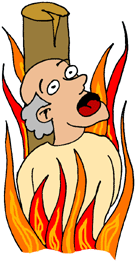
During the Tudor Reformation of the Church,
Windsor became poplar with Protestants. King Henry VIII was still
a Catholic at heart. He had them burnt
alive! But then changed his mind.
-
The famous
playwright, William Shakespeare, stayed at the (Hart &) Garter Inn
in Windsor in 1597. He wrote 'The Merry Wives of Windsor' there for
Queen Elizabeth I.
-
In Stuart
times, Sir Christopher
Wren built the Guild Hall in Windsor. He was a very clever architect who also
built St. Paul's Cathedral in London. His father was the Dean at St.
George's Chapel in Windsor.