|
|
|
|
|
 |
 |
|
||
|
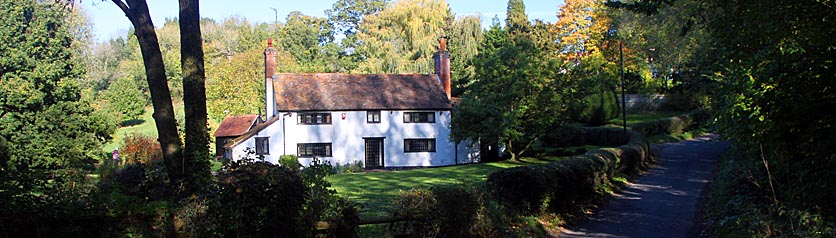
Midgham was anciently part of Thatcham parish. It was given to the Pinkney family after the Conquest, but they divided it into three sub-manors: Erley's Manor and two others of unknown name but which, for identification purposes, might be referred to as Midgham Chenduit and Midgham Everard. Erley's Manor was the most important and is represented by the present Midgham House. It was originally owned by the widespread Earley family of Earley Whiteknights, near Reading. Its most famous owner was the diplomat, Stephen Poyntz, who became governor and steward to the household of the young Prince William, Duke of Cumberland. The prince spent quite a lot of his childhood at Midgham House to which accommodation, long called the Duke's Rooms, was added. The much-altered house was pulled down in 1967. Poyntz' panelling, however, now graces the walls of Brimpton Millhouse, while Midgham's Dower House was lost in a game of cards and re-erected as a gatehouse at Aldermaston Court. A fourth manor-house, called Hall Court, became the vicarage in 1857. Midgham had its own chapel from at least 1309. It stood a little to the north-east of the present building, nearer Midgham House. The present church, of 13th century style, was erected by the architect John Johnson in 1869. There is an old story that it was built as the twin of Brimpton Church, so that two sisters could plant themselves in the towers and wave to each other across the Kennet Valley! Button Court, now Button Court Farm, at Midgham is built on land owned by the Button family as early as the mid-13th century. For several centuries, the present a 16th century house was owned by the Tull family and the ghost of a certain Jethro Tull is said to come and "jump about" there. This is not the famous agriculturalist who grew up at Bradfield, but another member of the same family. Another famous Midgham resident was the poet, William Crowe. He was born in a carpenter's cottage here in 1745. His fine voice enabled him to attend Winchester College and then New College, Oxford where he became a fellow and public orator of the University. His best known poem, on Lewesdon Hill (Dorset), was much admired by Coleridge and Wordsworth.
|
|
||
| © Nash Ford Publishing 2003. All Rights Reserved. | |
|||