|
|
|
|
|
 |
 |
|
||
|
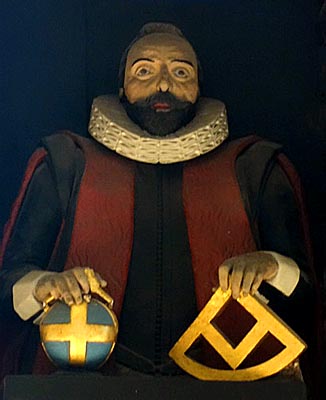 John
Blagrave (d. 1611) John
Blagrave (d. 1611)Born: circa 1561, probably at Bulmershe, Sonning, Berkshire Mathematician Died: 9th August 1611 at Southcote, Reading, Berkshire John
Blagrave, the famous mathematician, was the son of John Blagrave of Bulmershe
Court, near Sonning in
Berkshire, by Anne, daughter of Sir Anthony Hungerford of Down Ampney in
Gloucestershire (as well as East
Shefford). His father was a cousin of the Master of the Revels, Thomas
Blagrave. John was born in
Reading, but the date of his
birth is unknown: probably early in the 1560s. He received his early
education in his native town and, afterwards, entered St. John's College,
Oxford. He did not, however, take a degree, but retired to his home at Southcote
House (Reading). He also had houses on the Seven Bridges (Bridge
Street) in the town
and at Swallowfield. John
devoted himself to his favourite study of mathematics and became esteemed,
as Anthony Wood declares, “the flower of mathematicians of his age.” He
published four works: 1. The Mathematical Jewel, showing the making
and most excellent use of a singular instrument so called, in that it
performeth with wonderful dexterity whatever is to be done either by
quadrant, ship, circle, cylinder, ring, dial, horoscope, astrolabe, sphere,
globe or any such like heretofore devised (1585). 2. Baculum, Familliare
Catholicon sive Generale: a book of the making and use of a staff newly
invented by the author, called the Familiar Staff, as well for that it may
be made usually and familiarly to walk with as for that it performeth the
geometrical mensurations of all altitudes (1590). 3. Astrolabium Uranicum
Generale: a necessary and pleasant solace and recreation for navigators
in their long journeying (1596). 4. The Art of Dialling, in two parts
(1609). In
private life, Blagrave was distinguished for his charity, often concerning
himself with the well-being of others. His elder brother settled upon
him, in 1596, the lease for ninety-six years of the manor of Southcote, which
he in turn bequeathed this to his nephew, the regicide Daniel
Blagrave, and as many as eighty other relatives are said to have
benefited from his will. To his native town of Reading, he left certain
legacies, one of which provided annually the sum of twenty nobles to be
competed for by three maid servants of good character and five years'
service under one master, to be selected by the three parishes of the town.
The whimsical conditions of this bequest required that the maids should
appear on Good Friday in the town hall before the mayor and aldermen and,
there, cast lots for the prize. The losers had the right of competing a
second and third time. Blagrave died on 9th August 1611 and was buried, in the same grave as his mother, in the church of St. Lawrence in Reading, wherein an elaborate monument of himself, surrounded by allegorical figures, was erected by Gerard Christmas, though not to the very precise specification laid down in his will. He had married Dorothy, the daughter of Simon Gunter of Milton Lilbourne in Wiltshire (whose father came from Kintbury) and sister of Nicholas Gunter, sometime Mayor of Reading. She was a widow and her daughter, Jane, is named in John's will, but he left no issue. The step-daughter eventually married John's nephew, Edward Blagrave. His other nephews included Thomas and Robert Blagrave the brother musicians, and Joseph Blagrave the astrologer and his brother, the previously mentioned Daniel Blagrave. Edited from Leslie Stephen's 'Dictionary of National Biography' (1885)
|
|
||
| © Nash Ford Publishing 2001. All Rights Reserved. | |
|||